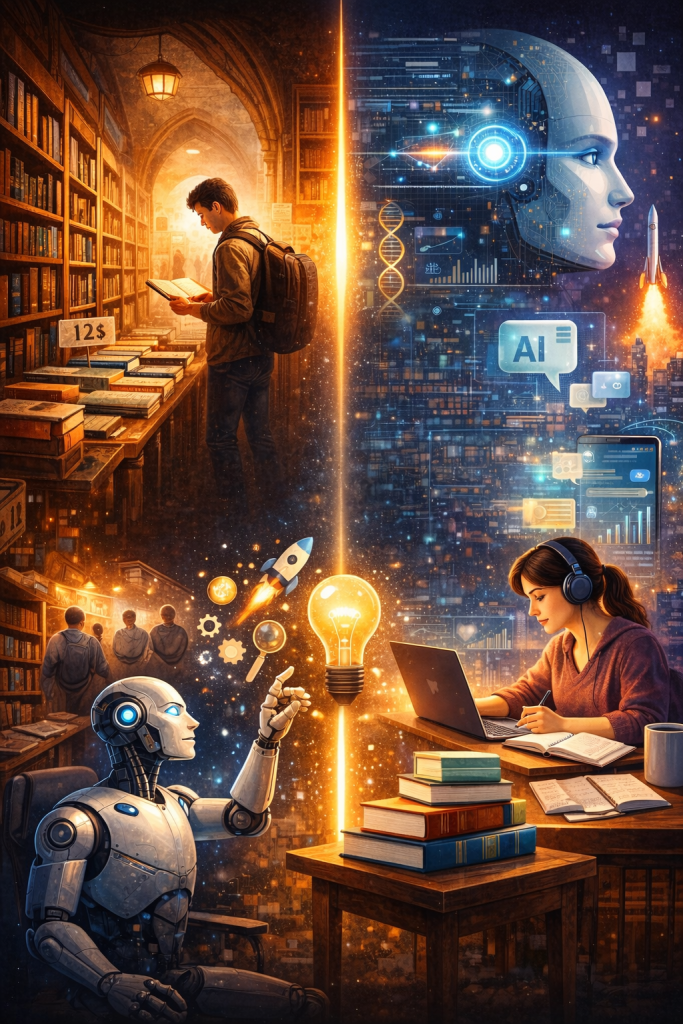
Not so long ago, learning meant physically searching for knowledge—and trusting what you found. When I was studying at university, in the years preceding the creation of the Web, I remember walking through what was known as the Engineering Hallway. It was a long hallway where informal booksellers offered books in many subject areas at cheaper prices. I spent hours browsing through the books, something the sellers encouraged. It was often easier to explore books there than in the library. Students trusted the books sold in the hallway because they were recommended by lecturers, so we did not question the reliability of these resources.
Things have changed. Students may no longer visit the Engineering Hallway to buy books as we did years ago, as technological evolution has made learning resources far more accessible through the Internet. Technology has clearly transformed the way we learn and grow—from having scarce, text-based resources to having vast learning materials available in multiple formats beyond text.
In the AI era, this shift has accelerated even further. Tools powered by AI now allow us to access information, learn new skills, and solve problems in minutes, reinforcing the importance of lifelong learning as an ongoing process rather than a one-time educational phase. However, this evolution has not come without challenges. In this article, we explore new ways of becoming lifelong learners and the challenges we face in today’s AI-driven world.
What is lifelong learning?
Lifelong learning is the ongoing and voluntary process of acquiring new knowledge and skills for personal or professional development through formal and informal education (UNESCO, 2025; JWU Online, 2024). It promotes the idea that learning never ends.
What are the benefits of lifelong learning?
In a rapidly changing world, lifelong learners are better able to adapt to job market conditions. For example, AI is disrupting many workplaces as organisations seek to improve productivity by incorporating AI tools that can replace tasks previously performed by humans. However, AI has also created new job opportunities. Lifelong learners can respond to these changes by learning how to use AI tools and applying them effectively in their current roles.
Lifelong learning also supports career advancement through upskilling, whether by enrolling in short courses or pursuing more formal study at tertiary education providers. Beyond professional development, lifelong learning contributes to personal growth. Individuals may take up new hobbies, explore fitness activities, or deepen their knowledge of topics of personal interest.
As lifelong learners develop expertise and expand their skills, they often feel more confident and motivated, particularly as they gain deeper knowledge in specific areas.
From the past to the AI era
In the past, lifelong learning was probably restricted mainly to formal education in schools, as learning resources were only accessible in public or personal libraries (or in the Engineering Hallway). In the early 2000s, this began to change with the growth of the web, as many learning resources became available through the Internet. Over the last two decades, we have seen a significant increase in online learning resources, making learning more accessible to a wider range of users. This has facilitated lifelong learning through informal means, such as instructional videos, online courses, podcasts, and similar resources.
AI has now created even more opportunities for lifelong learning through more interactive tools, such as chatbots, which are able to provide almost instant information on a vast range of topics. In just a few minutes, a generative AI tool can provide information about a topic and answer questions. This information can be delivered in several formats—text, audio, video, or a combination of these—tailored to individual learning needs.
Challenges in today’s AI context
As learning resources and tools have become more accessible through the Internet, the reliability of these resources has also become a challenge. For example, with the growth of the web, bloggers publish a vast amount of content that may have not been checked for accuracy. In addition, it is now well known that AI can produce incorrect outputs or biased information.
Overcoming challenges
Lifelong learning in the AI era goes beyond being an ongoing, voluntary, and self-motivated process of pursuing new knowledge. It also requires learners to critically evaluate the reliability of the content they consume. This may involve being more critical of information obtained from different sources, including outputs generated by AI tools. This may look simple to do, but it is not always the case, and I will explore this topic in another article.
To conclude, lifelong learning in the AI era is no longer just about continuous and voluntary learning, but about a critical process of acquiring new knowledge and skills in an increasingly complex digital world.
References
JWU Online. (2024, January 25). Lifelong Learning: What It Is and Why It Matters. Johnson & Wales University. https://online.jwu.edu/blog/lifelong-learning-what-it-is-and-why-it-matters/
UNESCO. (2025, February 13). Lilfelong learning for all. https://www.unesco.org/en/lifelong-learning/need-know
Read this article on Medium


Leave a Reply